
A black and white drawing of three gears on a white background.

Technical Programs

Electrical Safety in the Workplace for Mission Critical Facilities


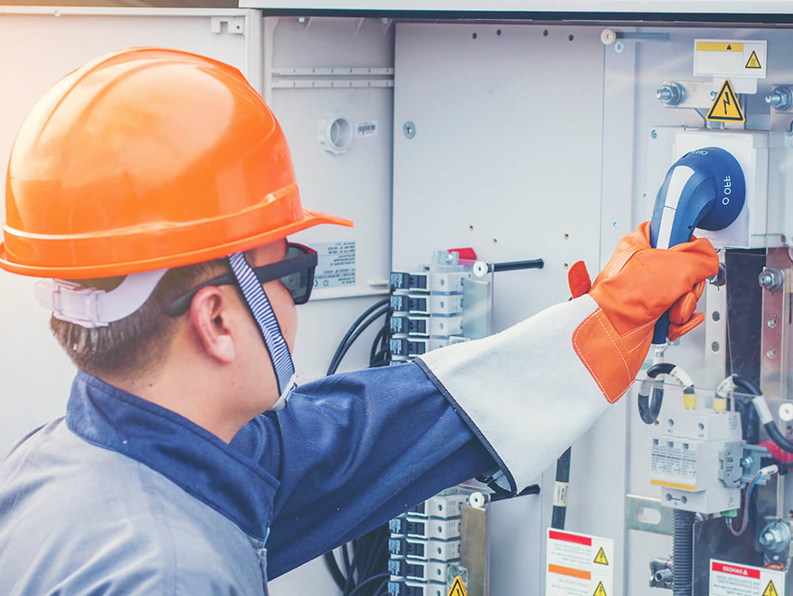
  • A man wearing a hard hat and goggles is working on an electrical box

    Slide title

    Write your caption here
    Button
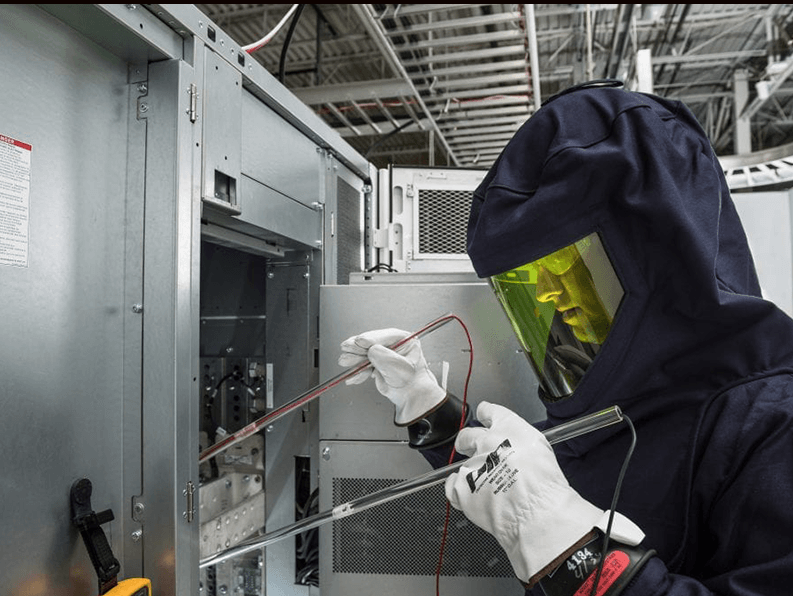
  • A man wearing a hard hat and gloves is working on an electrical box.

    Slide title

    Write your caption here
    Button
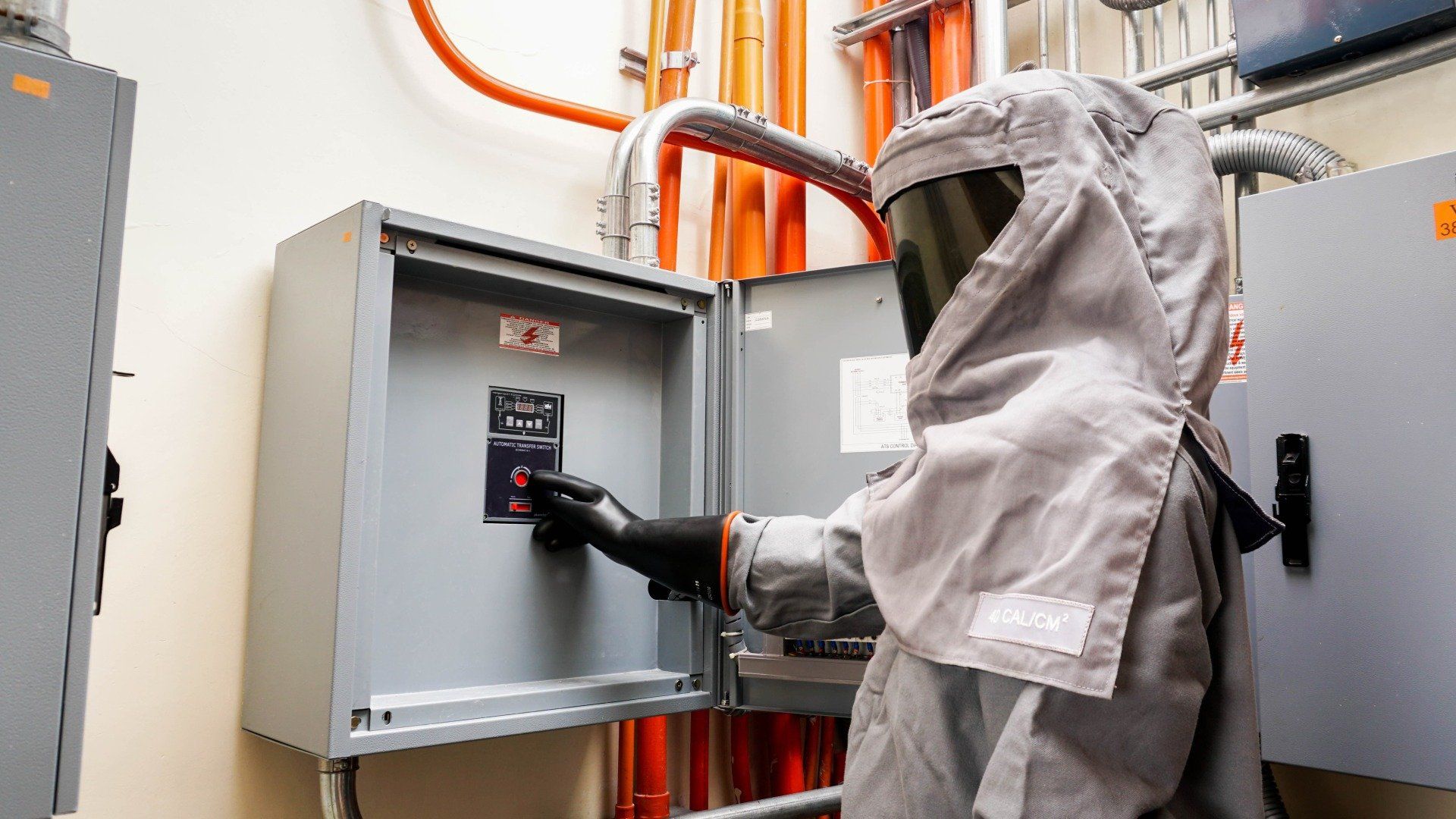
  • A man in a protective suit is working on an electrical box.

    Slide title

    Write your caption here
    Button
  • A man and a woman are working on an electrical box.

    Slide title

    Write your caption here
    Button
  • OVERVIEW

    This program will discuss excerpts from NFPA 70E Electrical Safety in The Workplace, its theory, applications, and practices that relate to work practices necessary to prevent workplace accidents. The program involves topics for protecting workers and physical assets in the workplace and promoting a safe and healthy environment.

  • WHY JOIN?

    Gain hands-on knowledge to minimize risks, ensure compliance with safety standards, and protect your facility from electrical hazards.

  • LEARNING OBJECTIVES

    By the end of this program, the participants will be able to:

    • Apply safe electrical work practices to reduce the risk of injury, equipment damage, and system failure.
    • Identify and evaluate electrical hazards, including shock, ground faults, and arc flash conditions.
    • Assess work area safety and implement controls aligned with electrical safety requirements.
    • Explain electrical system fundamentals, including grounding, protection methods, and system behavior.
    • Interpret online insulation resistance and residual current monitoring data in accordance with IEC 60364 to enhance protection against electrical shock.
    • Analyze protection schemes for grounded systems and their role in fault mitigation and personnel safety.
    • Explain the basic principles of arc flash hazards, including incident energy and arc flash boundaries.
    •  Interpret incident energy and arc flash boundary calculations based on IEEE 1584-2018 for informed safety and maintenance decisions.
  • TOPICS TO BE DISCUSSED

    Module 1: NFPA70E Electrical Safety in the Workplace

    This module introduces essential safety practices in the workplace as outlined by the NFPA 70E standards. It emphasizes the importance of proper procedures, protective equipment, and awareness to ensure a safe working environment when dealing with electrical hazards, helping employees understand the critical role of safety in preventing injuries and accidents.


    Module 2: Knowing Today What Should Never Happen Tomorrow

    This module focuses on building electrical safety awareness both inside and outside the workplace. By identifying potential hazards today, we can prevent incidents tomorrow, promoting proactive safety measures that safeguard workers and ensure compliance with safety protocols in various environments.


    Module 3: Arc Flash Risk Assessment Simulation Using Power System Software

    In this module, participants will explore the causes and effects of Arc Flash incidents, particularly in industrial settings. Through simulation and analysis using power system software, learners will gain the skills to assess arc flash risks, compute potential hazards, and understand how to prevent dangerous electrical events from occurring in real-world applications.

  • RESOURCE PERSON

    Engr. Jerome Pascual, REE

    Testing and Commissioning Engineer 

    Westco Electrical & Equipment Corp.


    Engr. Pascual graduated Bachelor of Science in Electrical Engineering from Technological Institute of the Philippines.


    He attended trainings such as: SKM Power System Software Orientation, Building Wiring and Safety, Power System Loss Minimization and Load Balancing Seminar. He also handles the Electrical System Study of Universal Robina Corp BOPP Plant and UFLEX Plant 1, to assess the technical implications whether the electrical system complies with the minimum electrical standards such as Philippine Electrical Code and other applicable standards.


    He is currently the Testing and Commissioning Engineer for Westco Electrical and Equipment Corp. and a resource speaker for Pamav Training Institute and Technology Center Inc.

  • REQUIREMENTS

    • No strict requirements required. 
    • Open to Electrical Engineers, Safety Officers, Registered Master Electricians, Electrical Technicians, Facility Engineers, Maintenance Personnel, Data Center Personnel, Building Engineers, Engineering Students, and individuals involved in mission critical facilities and electrical safety. 
    • Basic knowledge of electrical systems and workplace safety practices is an advantage but not mandatory.
  • TRAINING INCLUSIONS

    • Certificate of Attendance
    • E-Handouts
    • Meals (for in-person training)
    • Earn CPD Points for ELECTRICAL ENGINEERING COUNCIL

This program is accredited by:
Top Courses
Other Courses

  • Distance Protection

    In the first session of the program, we will discuss the basic measurement principle and construction of the distance protection. Distance protection is a complex protection and basic understanding of the protection makes the user extremely comfortable in working with this complex protection. This 2- hour webinar provides a good insight on the construction of the distance protection and some basic application criteria. This webinar will enable the protection engineers to feel extremely comfortable with the complex protection. Understanding the complexity of the protection increases system reliability and increases the productivity of the test engineers. 


    In the second 2-hour session we will concentrate mainly of testing and protection evaluation aspect. The meaningful testing of the complex digital protection will be discussed using the commercially available power system simulators. 


    Use of ComTrade data in protection evaluation will be discussed in detail. Learn more here.

  • Insulation Power Factor Training for Power Transformer

    This course provides participants  with current methods and procedures used internationally, on predictive, periodic or condition based maintenance  (condition base is - on line diagnostics and monitoring).


    The course is for substation maintenance staff or less experienced in power transformer tresting , or an experienced maintenance technical staff.  This program will also cater to advanced test engineer to learn new concepts in power transformer testing, oil recycling or oil filtering concept, and basic results interpretation. The course will also focus on issues related to causes of bushing breakdown, arresters, oil, impedance, leakage reactance and most of all short circuits rating a transformer can withstand. Learn more here.

  • Introduction to Partial Discharge Testing

    This training program will provide participants Introduction to basic application of Partial Discharge Testing in HV Electrical Assets in the substation.  This program will show how to measure, and how large  a partial discharge in a system? The partial discharge measurements also show the PD testers, how to use them show the   surge tests and PD spikes. Learn more here.

  • Competency Training on Power Quality and Harmonics

    This training is focused on  power quality issues that affects  the electrical system’s operations, more importantly when harmonic frequencies and its harmonic current and voltage affect the Distribution System that contributes to losses.  The Grid Code requires, commercial, highrise residential buildings,  industrial plants, and Utilities to comply within the  Standards.  The increasing demand and applications of non-linear load in industries nowadays greatly affects the quality of the power system.  This program will enhance the knowledge and practices of facility managers, maintenance and technical people at site and more importantly to save energy. Learn more here.

  • Fundamentals of Protective Relay

    Power system - Protective Relaying, in an electrical network  protects the electrical  system of a plant or any facility and it  requires analysis, calibration, troubleshooting on any unusual changes, faults, and disturbances. This seminar will cover  Protective relaying in power generation, transmission, distribution and large loads, furthermore, it will also provide a strong foundation of basic applications and advances in protective relaying that is very useful in planning, operating, and managing electric power systems. Learn more here.

  • Mechanical Integrity of Power Transformers using Sweep Frequency Response Analyzer

    This program provide participants a  comprehensive information on the diagnostic methodologies to evaluate the mechanical integrity of power  transformers. It will discuss the  basic principles of diagnostic assessments  with the use of sweep frequency response analyzer  and includes field case studies.

    This will also provide technical and maintenance  staff to determine some components of power transformer when internal parts had been affected by faults or when the unit is in transit and fell to the ground. Learn more here.


  • Thermal Imaging on Power Assets

    The program will provide participants on how to develop skills in measuring temperature of electrical assets, such as, power transformers, panels, switchgears, busduct, power cables, transformers enclosures, etc.  


    This thermal imaging program is developed for non-certification program, however participants would be able to use its thermal imaging camera effectively and with confidence.  Interpretation of results will also be discussed during hands on lecture.  Many have learned from this hands-on program and does not require certification to learn how to measure temperatures at different assets. Learn more here.

  • Digitalization of AVRs for Power Generators

    This training program will enhance the participant’s knowledge on power  generators or large motors in analyzing  analogue or digital automatic Voltage Regulators improve the power generator voltage output. or  for short  called  “AVR” – automatic voltage regulator, that controls desired & precise voltage, var and power regulation output. It is designed to regulate voltage output  automatically on power generators,  in example,  to take a fluctuating voltage level and turn it into a constant voltage level. Learn more here.

  • Dissolved Gas Analysis in Transformer Insulating Oil

    This seminar enhances a better understanding on how transformer insulating oil reacts after long use and for maintenance management and its technical team prepare for its maintenance programs.  This will also guide non chemist staff at site understand on how to read insulating oil analysis, specifically DGA and Oil Quality tests. Learn more here.

INQUIRE NOW